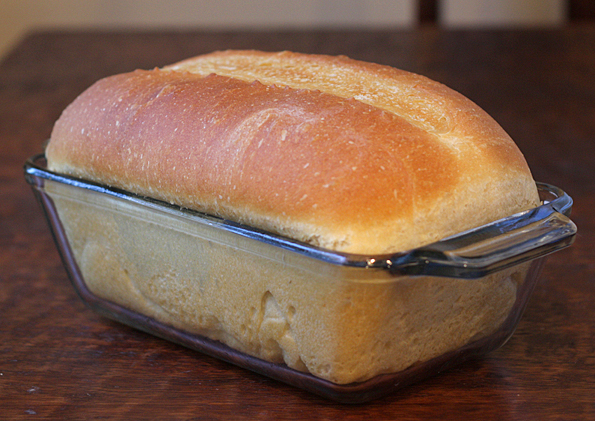
Ruhlman recently shared a recipe for a loaf of sandwich bread that I believe is about as easy as bread making gets. The recipe uses a weight measurement for the flour, rather than using a volume (cup) measurement. This is a great asset to the recipe, since the weight of a cup of flour can be drastically different depending on how you measure it. If you stick the measuring cup into your flour bin and scoop out your flour, your going to end up with a lot more flour in that cup than if you were to spoon your flour into the cup. The weight measurement helps reduce the margin of error. Most of the work is done by a stand mixer,
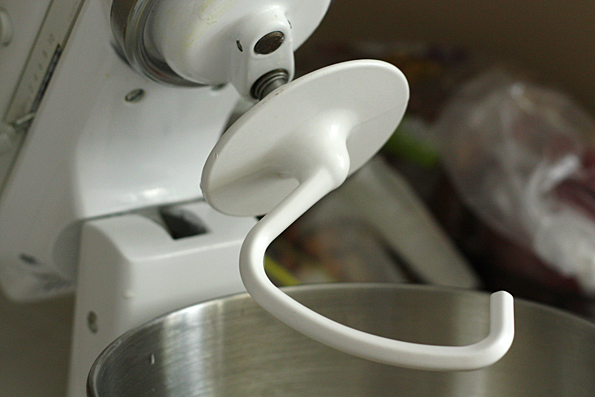
and then a brief amount of work is done by you—just a tiny bit of shaping.
The rest of the process really entails waiting: waiting for the bread to rise, letting the bread rest, waiting for the bread to rise a 2nd time, and then waiting for the bread to cook. Easy!
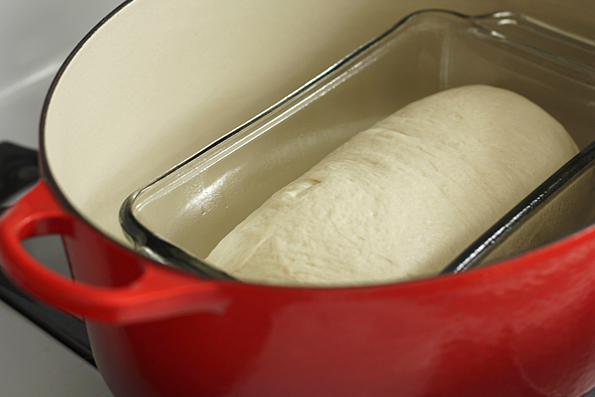
A few things to note that I especially appreciate about this recipe are the suggestion to use a Dutch oven, a note on the internal temperature of baked bread, and a reminder not to cut into the loaf right after it comes out of the oven. I learned the Dutch oven trick when I first made Jim Lahey’s recipe for No-Knead Bread. That bread, however, is a rustic boule that is baked directly on the bottom of the pot, not in a loaf pan like this bread, and so it didn’t even occur to me to use the same technique. Ruhlman suggests putting the loaf into a Dutch oven for the 2nd rise and for the 1st 30 minutes of baking time. This technique helps to seal in heat and moisture, which helps with the rising of the dough, and then acts like a steam-injected oven when baking. You can definitely make this bread without a Dutch oven, but it is such a nice bonus to use one!
Ruhlman notes that the bread is ready to come out of the oven when it reaches an internal temperature of about 200 degrees Fahrenheit. If you have ever worried about whether or not a loaf of bread is done or not, this is a fabulous way to know. I use an inexpensive thermometer that works like a charm.
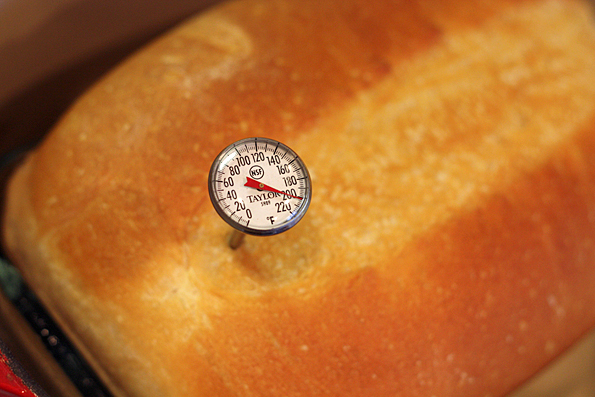
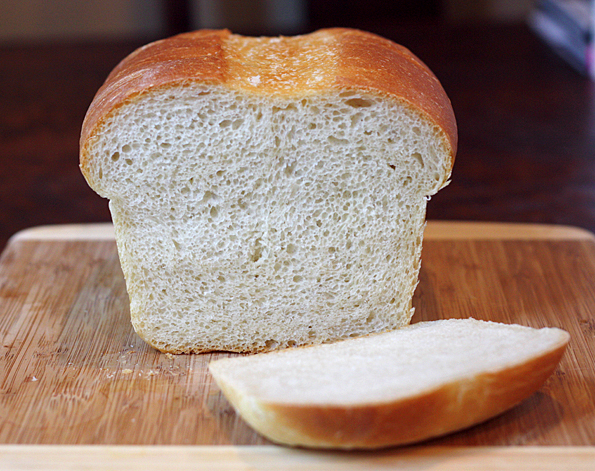
Finally, all of your “hard” work and temperature taking will be for naught if you cut into that loaf of bread when it comes out of the oven. Bread should be allowed to come to room temperature after baking, because the heat retained inside continues to cook the bread, so slicing it too early interrupts this process prematurely and could leave you with a gummy middle.
I’m going to help you make a goal/New Year’s resolution (whatever you want to call it) for 2010: “I (insert your name here) am going to make fresh bread from scratch this year.” See? That wasn’t so hard! Now go do it, and report back to me!
 Print This Recipe
“You can do it” Sandwich Bread
Adapted from Michael Ruhlman’s Everyday Sandwich Bread Recipe
Makes 1 loaf of bread
20 ounces all-purpose flour
12 ounces water
2 teaspoons salt
1 teaspoon active dry yeast
1. Combine all of the ingredients in the bowl of a standing mixer. Using the dough hook, mix the ingredients on medium speed until the dough is smooth and very elastic (about 10 minutes). Remove the bowl, cover it, and let it rise in a warm place until the dough has doubled in volume. This can take anywhere from 2 to 4 hours depending on how warm the area is where it is rising.
2. Remove the dough from the bowl, place it on a smooth surface, and then punch it down and knead it to get as much gas out as you can. Then shape the dough into a rectangle that is approximately 8×11-inches in size. Cover it with a towel and let it rest for 10 minutes.
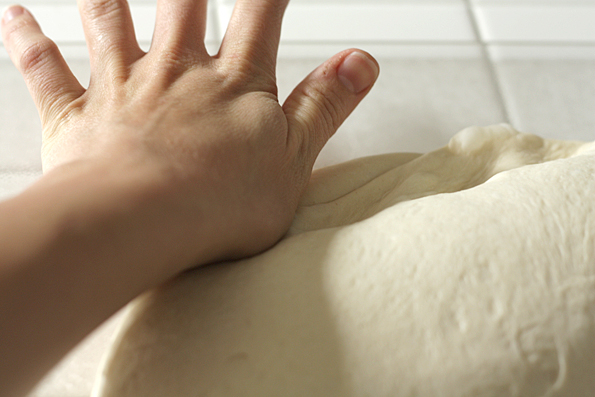
3. Shaping the dough: Fold the dough rectangle in half and then use the heel of your hand to press the halves together. Fold in half again, and repeat the process until you have a round loaf. Place it in an greased loaf pan, seam side down, and cover with a towel to rise (or place it in a Dutch oven and cover it) until it has doubled in volume (approximately 1 hour). While the dough is rising, preheat your oven to 450 degrees Fahrenheit.
4. When the dough has finished rising,use a sharp knife to make a slash down the center of the loaf. Make the cut about 1/4-inch deep at a 30 degree angle. Put the loaf into the oven and then turn down the heat to 350 degrees Fahrenheit. (If you are using a Dutch oven, leave the lid on for the first half hour.) Bake the bread for about one hour. For the best results, the internal temperature of the loaf should be about 200 degrees Fahrenheit. Remove the bread from the oven and let it cool before slicing into it.




{ 53 comments… read them below or add one }
Next Comments →
Beautiful post Rachael! I love the Dutch Oven trick ; ) Nothing like homemade bread fresh out of the oven!
Rachael, This is my goal! I failed miserably last week!! I am literally jumping that you posted this and the dutch oven trick! I’m seriously trying this recipe tomorrow and will let you know the results :D
Beautiful!!! I’m planning on doing Healthy Bread in 5’s sandwich bread! I hope mine comes out nearly as nice as this!!
Your bread looks beautiful! Ratio is one of my favorite books and I have been meaning to try to make some breads based on the ratios from the book.
I love homemade bread. The smell takes me back to my childhood.
Somehow, even though I was receiving every post on your old blog in my Google reader, I managed to miss the move to your new website. The other night, Husband and I made chicken katsu, and I realized I hadn’t seen a post from you in a while. Yesterday I looked you up and was so happy to find you are still blogging, so I updated my Google reader.
I bake my own bread every week (I really don’t care for the taste of store-bought loaves, unless they’re the nice (read: expensive) bakery breads. But I am so excited about this recipe and I’m looking forward to trying it!– and I just got a kitchen scale for Christmas! perfect!
qsogirl– I’m so glad you “found” me again! I’m not sure why that is happening to people…my RSS feed didn’t change! Something about the move set something off though! I’m with you, I can’t stand storebought bread! :b Let me know what you think of the bread!
Holy crap, that looks flawless. I’d love to make it, but I don’t have a stand mixer. How long would you have to knead it by hand for?
Heh, I actually made a loaf of bread a while ago, it’s not easy in my new apartment. I don’t have more than a foot of counter space at a stetch and no table. The bread came out good, it was especially nice after all the sweeping I had to do after I made it.
Bob– It would take a while…you’d mix it with a wooden spoon and then just start kneading the heck out of it. But not any worse than making any regular bread recipe without a stand mixer!
can’t wait to make this tonight after I get my converter sheet out..lol
This is definitely the reason why I have avoided making bread at home. You are so right! I can’t say I will promise to make it though as I don’t have that mixing equipment, so might have to get that first… :) But I will definitely come back to it.
Kelly– You could mix this by hand, it would just take significantly more elbow grease!
I am so going to do this, thank you for putting it out there! And I love the print link thingy – so cool and handy dandy!
Now I have to saw that I lost you for a while but I have fixed up bloglines so I will be able to keep up once again. Oh and my partner James finally tried our Melanganie recipe the other day…we are waiting until we can open the jar and try it. Will let you know.
Ah it’s great to be reading you again.
cheers
Kris in oz
Having never made non-breadmaker bread, I’d so love to be able to take you up on your wish to show me how easy it can be! I’m going to have to squeeze some sort of oven into my itty-bitty Tokyo apartment and will definitely try bread making once I do…
I’ve never made bread in a dutch oven before. I’ll have to try it out that way very soon. Your bread came out perfectly. There is nothing like making your own bread. YUM!
This loaf looks great, Rachael! I haven’t made bread for ages (last time it was a chocolate- filled roll!). The dutch oven idea is clever – I’ve baked bread with a roasting pan of water in the base of the oven, but this is a much better idea! I will try this as soon as I can. Thank you!
Ah bread. Next to macarons, it’s my nemesis. Maybe 2010 will be the year of the bread success…. Thanks for posting this – definitely filing for later use…
I’ve been looking for a simple sandwich bread recipe for days! This totally looks like something I could make. Definitely bookmarking this page!
I have been putting off getting a thermometer for ages, just can’t decide which kind. I want one that’s accurate for mostly roasting meats in the oven and would also love to use it as you did in the bread and trust what it tells me. I have found that you can spend as much or as little as you want with these things, and my question is, would this little Taylor thermometer be the answer for me?
Get your posts about every day – love them!
You make it look like it’s so easy! Can I use the same recipe with wholegrain flour?
Ah, you can read my mind. :)
I’ve been thinking about making sandwich bread to go with the next Washoku Warriors Challenge.
I just went to friend’s house for a bread demo because she felt exactly the same way. And you’re right! It’s not that hard! (She mills her own wheat too, so it’s super healthy!) And I gotta say it was way yummier than any store bought bread. I loved it. I think I’ll make it a new year’s resolution to bake at least TWO more loaves. Thanks for the inspiration!
Nice tasty bread recipe!
Thanks
Gaelle– If you want to use whole wheat flour, only replace up to half of the all-purpose flour in the recipe with this. If the whole wheat flour is coarsely ground, substitute 1 1/8 cup whole wheat flour for 1 cup all-purpose flour. The reason for not completely replacing the all-purpose flour with whole wheat flour is that whole wheat flour makes baked goods denser and coarser in texture. Hope that helps!
@Fuji Mama (Rachael),
If you want to use all whole wheat you can also substitute about 4 oz water for fresh orange juice. It’s a great little trick I figured out randomly at home one day. Most commercial improvers (how commercial ww is light and fluffy) are mostly citric acid. Don’t worry it won’t make your bread taste orangey! unless you want it to and then add some zest! An oz or 2 of honey or sugar would also help with gluten development in ww bread!
Arlene– Great question! Yes, I have had the same issue, especially when it seems like I buy a thermometer and then it doesn’t last very long. So frustrating! This particular thermometer was recommended to me by a very talented chef as being a great “all around thermometer.” I have definitely found this to be true. It’s not made for candy making, but that’s about it! The only downside is that the face is quite small (but wonderful that it doesn’t take up a bunch of room in a kitchen drawer). You can test the temperature accuracy (it comes with instructions on how to do this) and then recalibrate it if it is slightly off. I haven’t had any problems yet! For the price, it is especially a wonderful buy!
Nice job! I usually make ABin5 bread, but might have to try this method now. I just got a Dutch oven and wasn’t aware of this method so I’m going to have to give it a try.
One question, do you remove the bread from the loaf pan as you let it cool? I’ve found that leaving it in can result in a soggy bottom on the loaf.
I absolutely can’t wait until I get Michael’s book in the mail- just ordered it! That Dutch oven trick is one I’ve never heard of. I look forward to trying some new, healthy bread recipes this year.
You’ve made me want to try the Dutch Oven method. I too made the no knead bread a number of times last year using the oven, but haven’t gone the route of making other bread using this method. Thanks for posting this — now I’ve got the impetus to try it.
I got the book not long after it came out and have had the Ratio chart posted in my kitchen but the Ratio iPhone app is like a miracle. You can use weight or volume and use metric or imperial measurements. It’s pricy as iPhone apps go, but well worth it if you like to have the trials and tribulations of doing the math taken out of your hands.
Excellent post Rachael. And, yes, the difference between scooping and spooning a cup of flour is one-half ounce which is huge in baking.
Thanks for the “Dutch oven” trick. I make all of the bread we eat at home, using 2/3 spelt and the remainder AP flour. It’s just a simple white bread but I look forward to seeing if it comes out differently with the loaf pan inside my oval casserole. I noticed some comments about the lack of a stand mixer. I almost always use my Cuisinart to make the dough. Use the little plastic “s” rather than the larger metal one. I use cup measures and just dump in the flour, yeast, and a little sugar and pulse to mix. Then I put a funnel in the top opening and pour in a bit of olive oil and my water while the machine is running. The dough will come together into a ball and thump around in there. If not, I add a bit more water, or flour if it seems too sticky. It kneads very quickly so you don’t need to let it thump in there for more than a minute. Rise once as usual, form loaf and rise the second time. I bake mine in my grandmother’s old aluminum pans for 30 minutes at 350 degrees. Yes, remove from pan for better bottom crust and cool before slicing. Just found your blog so look forward to checking often. Thanks!
I am going to try this recipe this weekend. I love this baking method. I’ve been thinking about downloading Ratios on my iPad.
The no-knead bread is on my list too.
HI,
Summer holidays are here and I’ve started making bread to try and help my picky eater who’s now 13! We’ve made it twice this week – he made rolls with chocolate chips in but last night hunger drove him to a sandwich snack and he gave in and tried the bread he’d half heartedly made with me and LOVED IT! contrary as ever. So I’m going to give your recipe a try and see how he likes that. I must admit I prefer the idea of weighing the ingredients rather than measuring by cup! thanks.
LOVE this recipe! Turns out absolutely perfect every time!! :)
This recipe didnt even come CLOSE to working for me….. Bummed =(
@kristen — Too bad! It’s such a great recipe of Ruhlman’s. What didn’t work?
This isn’t my first time making bread and I’m on hour 3 and the dough isn’t rising at all. Am I crazy, or should there be sugar in this recipe?
@Phil R. — I’m not sure what to tell you about your dough not rising. I know the yeast amount is correct! Are you sure your yeast is still good? Nope, sugar is not necessary. If you want to add some, you can!
ummm,… isnt’ the liquid/flour ratio wayyyyy off? it’s way off.
@kristi — No, this uses a 5 parts flour to 3 parts water ratio (see Michael Ruhlman’s post about it here: http://ruhlman.com/2009/12/making-sandwich-bread-with-the-53-ratio/), so the ratio is correct!
report!
ive been trying to make a soft and fluffy bread but none turns out right, i wonder where goes wrong. it usually turns out too hard than i want it, but at least they are edible XD. the recipe i use:
Ingred 1:
300 gr mixed flour (Hard and Soft flour)
5 gr active dry yeast
Ingred 2:
50 gr butter
2 yellow egg
1 white egg
50~ ml milk (i usually add a little more)
about 50 gr sugar (usually use powdered one)
1 Tablespoon vanilla extract
Optional:
25 gr margarine (for kneading process if too sticky)
i can only make it with 300 gr flour because my oven is too small to fit it all at once. the hardest part is that i cant figure out when i have to take it out (dont have any thermometer). my small oven temperature only give out 100C 150C 200C 250C control knob.
i mix all Ingred 2 in a big bowl, mix the yeast in the flour, and then Ingred 1 into Ingred 2
then let it rise for 3 – 4 hours
im guessing to make it fluffy and soft, the dough needs to hold enough water. yet i always worried if i take it out too soon it will still lumpy inside. i dont have other parameter than the dough colour changing
i bake it at low temperature the first 10 mnts and 150C the last 10 mnts(i guess this is why it got hard and dry texture)
is there anyway to make it so fluffy and soft?
forget to add 25 gr whip cream powder into Ingred 2
and lately i dont let it rise for 4 hours, 3 hours the longest, usually 2 hours because i use the first 10 mnts 100C to make it rise faster
TEACH ME HOW TO COOL
teach me how to cook
I’m not certain the place you are getting your information, however good topic.
I needs to spend a while learning more or understanding more.
Thank you for magnificent information I was searching for this information for my mission.
Curious how large your dutch oven is?
Hi,
Can you describe how to do the Dutch oven trick. I didn´t understand very well by the picture.
Thanks!
Good heavens! Measure your ingredients by weight! What a good idea! Oh no. I forgot. That’s what we’ve been doing in Europe for the past 100 years. I never use a US recipe because of the vague measurements.
Hello. I would like to attempt this using the same method shown above with loaf pan within the cast iron Dutch oven. Does this method create the same steam infusion effect even if the dough itself is housed in a loaf pan? Many thanks, MJ in Nova Scotia
Can you use bread flour in this? If so, does it need any modifications?
First off, I really appreciate the author of going to the trouble of putting this recipe up.
But I have to say, this is incredibly far from “simple”. The fiddliness with “if you have a dutch oven”, and especially the “turn the oven to 450” and then “no, wait, NOW turn it to 350” leave a lot of room for this recipe to get messed up. I managed to get everything all the way and then messed it up with turning the temperature down. So now I’m trying to rescue what is currently 165 degrees in the center but starting to turn dangerously dark on the top.
First, this recipe should be broken into two totally different ones: the one with a dutch oven and the one without.
Second, it needs to be broken into far more steps. Long paragraphs are easy to get lost in. The last two paragraphs should be something like this (dutch oven version):
——————————————————-
3. Shaping the dough: Fold the dough rectangle in half and then use the heel of your hand to press the halves together. Fold in half again, and repeat the process until you have a round loaf.
4. Place dough in a covered Dutch oven until it has doubled in volume (approximately 1 hour).
5. While the dough is rising, preheat your oven to 450 degrees Fahrenheit.
6. When the dough has finished rising,use a sharp knife to make a slash down the center of the loaf. Make the cut about 1/4-inch deep at a 30 degree angle.
7. Put the dutch oven with lid on into the oven and then turn down the heat to 350 degrees Fahrenheit.
8. Bake the bread for 30 minutes.
9. Remove the dutch oven lid.
10. Bake for about 30 more minutes. For the best results, the internal temperature of the loaf should be about 200 degrees Fahrenheit.
11. Remove the bread from the oven and let it cool before slicing into it.
——————————————————-
Only now rewriting it do I realize you actually didn’t seem to mean to put it in the loaf pan and then put it in the dutch oven to do the final rise. See what I mean by confusing?
Like I said, I appreciate you putting this out there. But I think you’re so used to it that you’ve missed the complexity and written it for a different audience than you think.
Thanks for the feedback! I’m always trying to improve my recipe writing, and hopefully I’ve done that in the 9 years since I wrote this post.
I just wanted to say that even with my issues, the bread turned out DELICIOUS. This is literally the first non-quickbread I’ve made that I think was a success. So even without your years of writing improvement, you helped me reach that mileston. THANK YOU. I’ve wanted to bake my own bread for years and years and have had several false starts that led to momentum-killing disasters. All of them were no-knead bread, for what that’s worth. This was the first recipe I tried with our new KitchenAid. There were plenty of times I was sure it was going to end terribly. But instead I have to force myself to stop devouring it! Here’s a snapshot: https://i.imgur.com/OmgVyD3.jpg
If you have a newer recipe you’d suggest in place of this one, I’d love to see it. Also would be interested in a recipe you’d suggest for a beginner like me to make a whole wheat loaf (perhaps with some seeds thrown in, as my wife and kids love that).
{ 3 trackbacks }