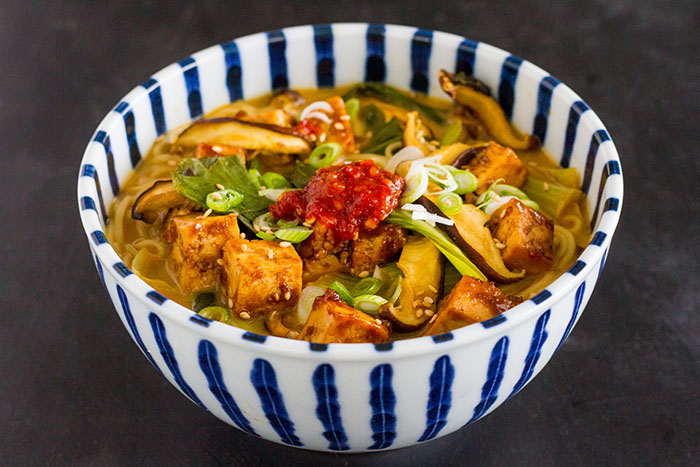

How to make tofu—no fancy equipment required.
In the U.S., tofu tends to be viewed as a health food. Living in Japan really changed my views on tofu, as it is a staple food item there. When you go into a supermarket in Japan, there’s an entire tofu section (like the cheese section in our American supermarkets), filled with different varieties and brands of tofu. Some of the varieties are equivalent to the mass-produced tofu you can find here in your local supermarket, but then there are also the artisanal varieties. Taking your first taste of one of these varieties is akin to tasting your first homegrown tomato. My first thought was, “What? This is tofu?” It’s hard to really even compare the two! The great thing is, you don’t have to travel to Japan to taste artisanal tofu–you can make your own at home, and you don’t even need to go out and buy any fancy equipment. If you end up liking your homemade tofu and want to make it again, the one piece of equipment you might consider purchasing is a tofu press so that your tofu ends up in a block shape. But even that is not really a large investment as several Internet sources provide options that cost less than $20!
 One of the keys to making good tofu is using quality ingredients. I’ve found that the cheapest (and yummiest) dried soybeans are from my local organic market where I can buy them in bulk (as opposed to small packages of beans).
 For water, spring water yields the smoothest and most pleasant flavor. Even if you only use spring water in the second half of the process, this will still make a difference in flavor.
How to make tofu in your kitchen (aka, no fancy equipment/ingredients required).
Ingredients needed:
– 1 1/3 cups dried soybeans
– Coagulant: You have several choices in this department:
1) 2 tsp. liquid nigari or
2) 2 1/4 tsp. granular or powdered nigari or
3) 2 tsp. Epsom salts (magnesium sulfate) or
4) 4 Tbsp. lemon juice (freshly squeezed) or
5) 3 Tbsp. apple cider vinegar
Although traditional tofu is made with nigari (a concentrated solution of various salts remaining after the crystallization of salt from seawater), tofu can be made with one of the other ingredients listed above (see, I told you that you didn’t need any fancy ingredients).
 The coagulant you choose will effect the taste and firmness slightly, but it will still be tofu, and it will still be yummy! After you’ve tried one coagulant, you may want to try another and see if you prefer one over the other or if you even care.
Okay, now let’s get started on the actual process of making our own tofu. First we need to make soy milk:
1. Soak the dried soybeans in 4 1/2 cups water for at least 8 hours (you’ll need to soak them longer if it’s cold). I usually soak mine overnight or up to 24 hours if it’s chilly out.
 2. Grind the soybeans in batches with their soaking water in a food processor/blender until the beans are ground fine.

 3. In a large pot, bring 5 cups of water to a boil and then add the ground soybeans.
4. Over medium heat, bring the mixture almost to a boil stirring continuously with a wooden spoon to prevent sticking. Right before it comes to a boil, reduce the heat to low and cook the beans for an additional 8 minutes, stirring (it will foam up A LOT during this process. If the foam gets to high, just flick a few drops of cold water over the top. That should cause the foam level to fall back down.
 5. Strain the hot mixture through a colander lined with a finely woven cotton cloth that is sitting over a bowl or pot. You want to catch the liquid–that liquid is your soy milk which you’ll be using now to make your tofu.

 6. Carefully gather up the sides of your cloth and twist it closed (you may want to wear gloves to protect your hands from the heat). Using a jar or potato masher, press sack against colander, squeezing out as much soy milk as possible. You will be surprised at how much you will be able to squeeze out!


 7. The pulp left in the cloth is called okara and is very nutritious (I’ll be giving you some ideas on how to use it later in the week).

Okay, now to make the actual tofu:
8. In a cup, mix together your chosen coagulant with 1 cup water and stir until dissolved.
 9. Quickly rinse out the cooking pot and put it back on the stove. Transfer the soy milk to the pot, and cook it over low heat, stirring continuously with a wooden spatula. When the the soy milk is between 150 to 155 degrees Fahrenheit, remove the pot from the heat.
 10. Add half of the coagulant mixture to the soy milk, stirring with a spatula in a whirlpool pattern. After stirring vigorously 5 or 6 times, bring spoon to a halt upright in the soy milk and wait until all turbulence ceases. Then add the remaining coagulant mixture, and this time stir gently in a figure eight pattern. When you notice that the soy milk is beginning to coagulate, cover the pot and let it sit for 15 minutes.
 11. Line a colander with a clean tightly woven cotton cloth and set the colander over a bowl that can support it, or in the kitchen sink. With a soup ladle, gently transfer the coagulated soy milk into the cloth-lined colander (or tofu press if you’re using one).

 12. Fold the cloth over the top of the coagulated soy milk, and place a weight of about 1 1/2 pounds on top and let stand for about 15 minutes (I use a very scientific weight system of canned goods). I like to place something between the tofu and the weight (like a plate) so that the weight is evenly distributed and gives better shaped tofu. This pressing process is to press out excess water and make the tofu firm.
 13. Place a large bowl in the sink and fill it with cold water. Remove the weight from the tofu, unfold the cloth, and gently transfer the tofu into the bowl of cold water. Gently run cold water from the tap into the bowl for 15 minutes, without letting the water hit the tofu directly.

 14. Serve the tofu immediately or store it in fresh cold water in the refrigerator.
 If you made your tofu in a colander, you will end up with some odd shaped pieces,
 but once you chop it up, no one will know, and it will still be just as delicious!

Still not convinced that you want to put in the time and effort to make tofu? Tomorrow I’ll be sharing a method for making quick tofu that takes less than an hour from start to finish.
Tofu Making Resources:
– Recipe: My recipe is a result of trial and error and these three wonderful books: The Book of Tofu, The Tofu Book: the New American Cuisine, and The Japanese Kitchen.
– Tofu press and coagulants: Amazon.com carries a small press as well as nigari, but the same press can be bought through the Soy Milk Maker wholesale Website for almost a quarter of the cost. They also sell a larger wooden press, as well as several coagulants. This is where I’ve been buying my supplies, and they’ve been wonderful to work with so far. These items are also often available at Asian markets, so check those if any are nearby before ordering anything online!