Have you voted yet today? You can vote once every day between now and December 31st! Help me win the title of favorite Crescent Cook and be entered for the chance to win $5,000! You have to fill out the entire form below the pictures and set up an account for your vote to count. After registering the first time, you then have to log in for each subsequent vote (log in area is at the top of the page), hit the vote button, then scroll down and hit the “Enter Now” button. You’ll know that your vote has been counted if you then get a screen that starts with, “Thank you for entering the My Crescent Wow Sweepstakes!” Thank you so much for your support!!
=============================================
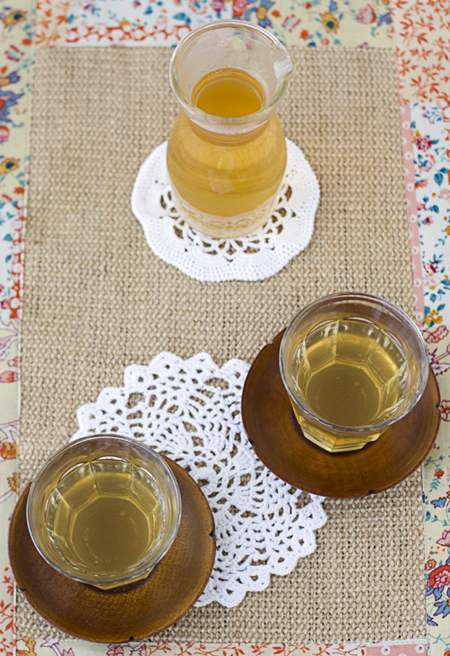
When I started dating Mr. Fuji, he introduced me to mugicha (pronounced “moo-gee-cha”), a Japanese “tea” made from roasted barley that is often served chilled. Mr. Fuji had lived in Japan on two separate occasions by the time I met him, and so he was well acquainted with the drink, as it’s a popular summertime beverage in Japan. Its wonderful toasted grain flavor quickly grew on me, but it wasn’t until we moved to Japan during the hot and humid summer of 2002 that I gained a true appreciation of its virtues. Before living in Japan, I had never lived in a humid climate. I grew up in dry Southern California and went to undergraduate school in dry Utah. The pervasiveness of the humidity in Japan took me by surprise. It wasn’t like the dry heat that I was used to, where you could step into the shade and gain a bit of relief from the beating rays of the sun. Humidity follows you wherever you go, constantly reminding you of its presence by making you feel as if a hot damp flannel blanket has been wrapped around your entire body. Even once you step into an air-conditioned space, it takes quite a bit of time for your body to adjust and fully cool off.
I remember walking to the train station near our house one day on my way to work, about a week after we had moved to Tokyo, wishing I could start stripping off pieces of clothing and then douse myself in a bucket of ice water. Even once I made it to the station and got onto the train, there was no relief to be found, as I was packed like a sardine into a train car with my fellow passengers, bodies pressed tightly against each other, each radiating too much body heat for anyone to ever be comfortable. It was that day at work, that I remembered Mr. Fuji telling me that people say mugicha is more refreshing than water during the summer. On my lunch break I went to the convenience store across the street, bought a cold bottle of mugicha, twisted open the lid, and took a sip. That first sip tasted so divinely good that I took another, and another, until only a few drops were left at the bottom of the bottle. I immediately went back inside the convenience store and bought two more bottles for the rest of the day. I don’t think I ever left the house after that day without a bottle of mugicha in my bag. Though after that, I started brewing my own at home. Since then we have almost always had a pitcher of mugicha sitting in our refrigerator. Squirrel and Bug have grown up always having one of two things in their sippy cups: milk or mugicha. Mr. Fuji was right—nothing is more refreshing than a glass of cold mugicha on a hot day. I don’t know what it is, but it cuts through my thirst quicker than any glass of water. On top of being refreshingly delicious, it is naturally caffeine and calorie free and is said to be wonderful for indigestion and an overall system cleanser (not that I need any convincing to drink it).
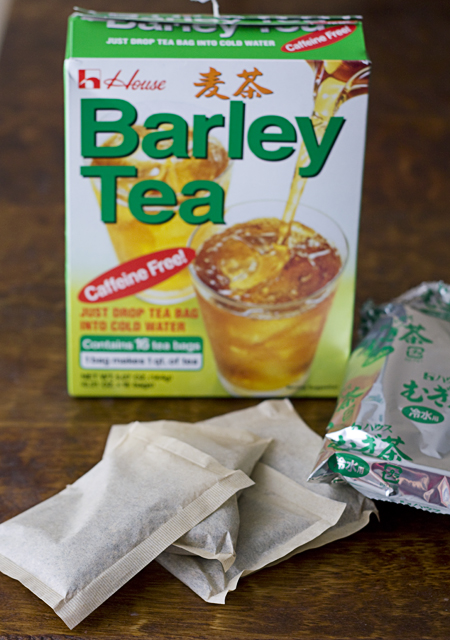
A few weeks ago as I pulled a tea bag out of my cupboard and put it in a pitcher of water to steep, I started to wonder about the process of actually roasting the barley. I know that there are many people who may not have access to an Asian market, and so wouldn’t be able to just pop over to the store to buy a box of mugicha. I figured it couldn’t be that difficult, considering it only contains one ingredient—grains of barley that have been roasted until they are dark and fragrant. I cut open a tea bag to examine the contents and it didn’t look much like the bags of pearl barley you find at the grocery store. So I did some research and learned that the barley roasted to make mugicha is actually unhulled barley grains. I couldn’t find a store near me that carried unhulled barley, so I decided to experiment with regular old, easy to find pearl barley. I bought a big bag of it in the bulk section of a local organic market for less than $2.00 (score!).
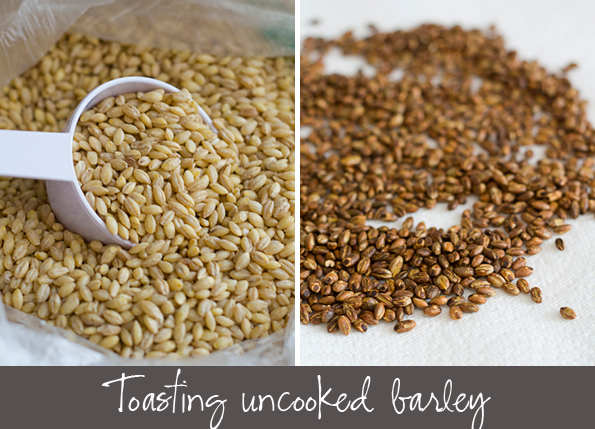
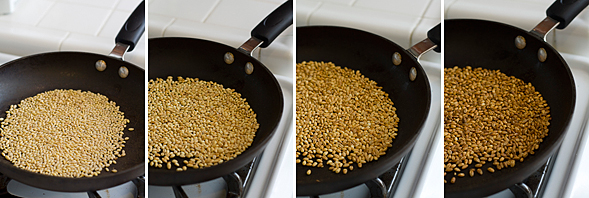
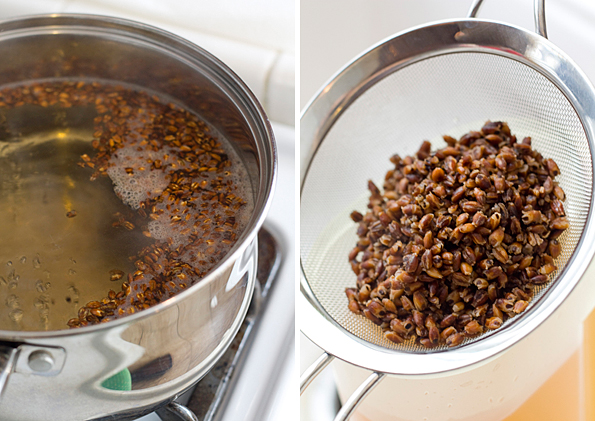
This past Sunday I was finally feeling well enough to spend a few minutes out of bed stretching my legs. I thought a glass of mugicha would taste and feel wonderful on my raw healing throat, and so decided to give making it a go. Toasting the barley was a quick and simple process. All I did was cook some in a large dry skillet over medium heat, slowly toasting the grains until they turned a rich dark brown color.
Then I simmered the toasted barley in some boiling water over low heat for a while, and then removed it from the heat and let it continue to steep as it cooled slightly. Finally, I strained out the barley, poured the mugicha into a pitcher, and put it in the fridge to chill.
When it was finally chilled, I eagerly poured myself a glass. The first thing I noticed was that it was a bit lighter in color than the mugicha I usually made from store bought tea bags and I thought that this would translate into a lack of flavor. I took a sip and was pleasantly surprised by the wonderful taste of the liquid. It definitely tasted like mugicha, but it was sweeter and had a slight floral note to it that isn’t present in the mugicha I’m used to drinking. Not only did it taste delicious, but it was like balm on my aching throat. My family is just as enamored with it, especially my mom, who has been enjoying several glasses of it when she comes to help me with the girls. Although fall officially starts in just a few days (September 22nd this year!), I don’t think I’ll be putting away the barley anytime soon. We will continue drinking our mugicha year round. And hey, during the winter when it’s cold, it will feel good to stand next to the warm stove toasting the grains of barley. I can hear it now . . . “Barley roasting on an open fire . . . .” (Yeah, I’m corny, I know. I just couldn’t help myself)
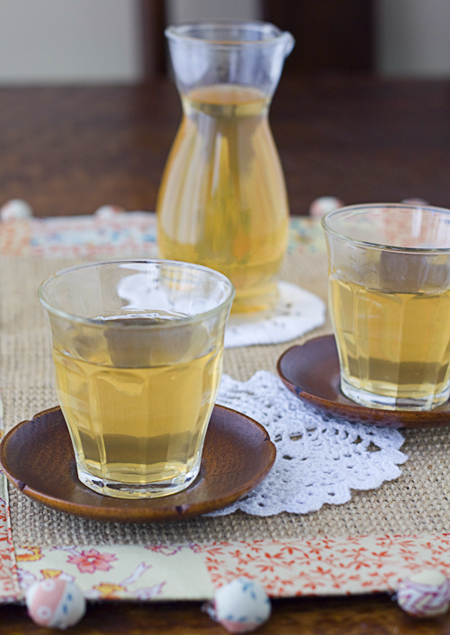
Homemade Mugicha (Japanese Roasted Barley Tea)
Makes 8 cups
1/3 cup uncooked pearl barley
8 cups water
1. Put the barley in a large dry skillet and toast over medium heat for about 10 minutes, stirring the grains and shaking the skillet occasionally so that they toast evenly, until the grains have turned a dark rich brown color. Remove from the heat and pour out into a bowl or a paper towel to cool.
2. Bring the water to a boil in a pot, add the cooled toasted barley, and simmer over low heat for 20 minutes. Remove from the heat and let the barley continue to steep as the mugicha cools, for about 5 minutes.
3. Strain out the barley, pour the mugicha into a pitcher and chill.
============================================
P.S. If anyone is trying to think of something to give me for Christmas this year, I think this “Got Mugicha?” bag would make a wonderful gift. It’s never too early to start preparing for the holidays. Just sayin’.


{ 27 comments… read them below or add one }
This looks delicious! I’m a big barley fan, so I can’t wait to try this. Move over sweet tea, your healthier cousin is coming in!
Rachael! OK, your photos are just beautiful! Tea has never looked so good :) And I’m with you on fall being the best season. I can’t wait until it arrives here in Tokyo! xx Rachael
Mugicha is virtually identical to cebada, a drink in Peru made from toasted unhulled barley. I wonder if this was a Japanese/Peruvian crossover (Peru has a history of Japanese immigration). Cebada is served cold with sugar and lime juice. It’s also made into a powder and served as a coffee substitute for breakfast or supper, with hot milk or water. Also, funny you should mention the difficulty of buying unhulled barley: here in Peru, I cannot find hulled barley for cooking, only unhulled!
Thank you for the recipe! One of favorites from Japan is the tea with roasted rice. I crave the cold green tea by Itoen, but we don’t have it up here in the California Sierra’s. Now I am going to try Barley/Mugicha.
wow, this is super easy! i’m wondering how much barley costs at the store. :) i will have to run down and find out. i loved barley tea when i lived in japan! yummy.
Glad to hear you are doing better Rachael, thank you so much for introducing us to Mugicha… it sounds so refreshing I’m definitely giving it a try! :)
We will try this. Josh loves hot tea in the winter! I hope you are feeling better! Hang in there!
My mum is English and I was born there and lived there until I was 10. We always had lemon and barley water to drink. You can buy it here (and I do) in a bottle and then you dilute it. You have inspired me! I am out to buy barley and think I will try my hand at lemon barley water. It is slightly sweetened though so I may have to add a little sugar to it. Thanks!
Mugicha! Even though the first time I heard/tasted it was only about 2 months ago, I’ve rapidly fallen in love with this drink.
Growing up (and even now) I always have access to vats of chilled boiled barley water made with pandanus leaves and a squeeze of lime. It was refreshing and yummy, perfect for humid weather. Now that I live in the UK, the ‘barley water’ squash drinks are just not the same.
Mugicha however, I totally love. The roasted flavour reminds me of genmaicha which I really love as well. Thanks for the recipe, I thought I had to buy unhulled barley which is pretty hard to source.
I grow a couple of pots full of barley every year… i think i’ll have to make this with some of my harvest :)
Thanks!
Koreans drink this too. I ask for it every time I go to a Korean restaurant! It is refreshing and an excellent palette cleanser.
Here is the Gateau Mousse au Chocolat recipe…
10 oz plain chocolate, chopped
4 oz unsalted butter, cut into pieces
8 eggs, separated
1/4 tsp cream of tartar
3 tbsp brandy or rum (optional)
chocolate curls, to decorate
For the chocolate ganache…
8 fl oz double cream
8 oz plain chocolate, chopped
2 tbsp brandy or rum (optional)
1 oz unsalted butter, softened
1. Preheat the oven 350*F. Lightly butter two 2 8-9 inch springform tins and line the bases w/buttered greaseproof paper or non-stick baking paper.
2. In a saucepan, melt the chocolate and butter over a low heat until smooth, stirring frequently. Remove the pan from the heat and whisk in the egg yolks until completely blended. Beat in the brandy or rum, if using, and pour into a large bowl. Set aside, stirring occasionally.
3. In a clean greasefree bowl, using an electric mixer, beat the egg whites slowly until frothy. Add the cream of tartar, increase the speed and continue beating until they form soft peaks, then stiffer peaks – that just flop over the top.
4. Stir a large spoonful of whites into the chocolate mixture to lighten it, then fold in the remaining whites until they are just combined – don’t worry about a few white streaks.
5. Divide about two-thirds of the mousse between the two prepared tins, smoothing the tops evenly, and tap gently to release any air bubbles. Chill the remaining mousse.
6. Bake for 30-35 minutes until puffed; the cakes will fall slightly. Cool on a wire rack for 15 minutes, then remove the sides of the tins and leave to cool completely. Invert the cakes on to the rack, remove the cake tin bases and peel off the papers. Wash the cake tins and dry thoroughly.
7. To assemble the cake, place one layer, flat side down in one of the clean tins. Spread the remaining mousse over the surface, smoothing the top. Top with the second cake layer, flat side up. Press down gently so the mousse is evenly distributed. Chill for 2-4 hours or overnight.
8. To make the ganache, bring the cream to the boil in a heavy saucepan over a medium-high heat. Remove the pan from the heat and add the chocolate all at once, stirring until melted and smooth. Stir in the brandy or rum, if using, and beat in the softened butter. Set aside for about 5 minutes to thicken slightly (ganache should coat the back of the spoon in a thick smooth layer).
9. Run a knife around the edge of the assembled cake to loosen it, then remove the sides of the tin. Invert the cake on to a wire rack, remove the base and place the rack over a baking tray. Pour the warm ganache over the cake all at once, tilting gently to help spread it evenly on all surfaces. Use a palette knife to smooth the sides, decorate the top with chocolate curls, then leave to set.
Enjoy! :)
Rachael, does Mugicha taste anything like Genmatcha Green tea? I love the roasted flavor of the rice in that tea. Must try this—-sounds simple, healthy & delicious. Glad to hear it is feeling good on your throat. By the way your blog re-do looks amazing! xo
Thank you for the recipe! I recently read about this type of tea, and was intrigued. Now I can try it at home. And applause to you for letting your kids drink this! My two year old enjoys all sorts of ice tea too – I think many parents just assume their child wouldn’t like something, and don’t give them the opportunity to try. A nice change from regular old apple juice!
I LOVE mugicha (great for the skin!) but I have to say I usually buy the bottled stuff. Thank you for posting the recipe so now I can make it at home. Love your beautiful photos!
here’s what i’d like to know…how have i not found this blog before now!? absolutely amazing, your story is incredible, and truly can’t wait to read more! this post is gorgeous :)
That sounds great! It gave me an idea – make some tea with malted barley grains that I have on hand for making homebrew. I usually save the barley grain/hulls after steeping and sparging and, then, dry it in the oven, grind it, and use it to make bread. Makes a delicious roasted barley flavor bread!
You can buy malted barley grain at any homebrew supply store or online (e.g. MoreBeer) quite cheap. Since it has been malted (germinated and dried), it is more extractable than plain barley grain (whole barley grain can usually be found in food co-ops). Whole grain barley is a bear to cook with – that’s why it is usually “pearled” to remove the tough outer hull (which turns into rubber when you try to cook it!!!).
This is such an interesting way of drinking barley. Over here in Malaysia, we have our our barley boiled with screwpine leaves and rock/palm sugar (whichever available). Always a great way to alleviate thirst. It’s said to be good for cleansing women’s urinary tract. The dr told me that. Anyway, I’ll definitely test this method out! Lovely :-)
oh, and lovely new layout & header :-)
I’ve never heard of this before – fascinating. Love your stories about living in Japan!
I didn’t know about that tea. I want to try it asap.
We love barley, we make home made beer, so it’s time I learn how to do mugicha. It looks a sort natural and easy consequence of our passion. I let you know the result:)
Thanks for the lovely tea recipe!! In fact, i was reading in this book “Inner peace, outer beauty : natural Japanese health and beauty secrets revealed by Leigh, Michelle D” about the benefits of pearl barley and wanted to try this tea recipe that was in the book. It says that pearl barley is excellent for getting rid of any types of skin problems. It is also a great skin lightener. Most of the times, i have seen people including myself, only care for the skin externally and desire to achieve a flawless complexion. This tea benefits the skin internally in so many ways and having a cup of this tea everyday should ward off most of your health problems.
I work for a farm that grows barley and am trying to make my own mugicha. I only had access to pearled (with the hulls off barley) too, so I put it it in a pan to roast and… my barley started popping! Like popcorn! It did turn a little dark as it roasted, but many of the grains popped! Was not expecting that. Did any of your grains pop? I wonder if it has to do with moisture in fresh vs. stored grains. Oh well, we’ll see how it turns out!
Would the cooked barley still be suitable for a salad dish? It seems a shame to throw it away.
If you mix mugi-cha and milk it tastes like Go-go-no ko-cha! Yum.
Many years ago I toasted my pearled Barley in a low oven to make this tea .I liked it a lot., and have made it many times since 1975.I wanted to go to Japan at that time.
Hey,
That mugicha looks lovely! I used to have it frequently when I was in the US. But after I moved to India, I’ve been struggling to find mugicha packets. So I tried brewing it at home.
My mugicha was not a clear liquid like yours. It was dark brown and cloudy and didn’t taste like mugicha at all! After a day, it even started to smell funny. I threw the rest of it away and tried not to think about the disaster! Any idea what could have gone wrong?
{ 2 trackbacks }